
Constitutionally Speaking Rotating Header Image

On Nelson Mandela

Today twenty years ago exactly Nelson Mandela was finally released from prison after serving 27 years of his sentence for life imprisonment. It was a very hot day in Cape Town and the 100 000 strong crowd was baking in the sun. Most of us either had no money to go and buy water or were too scared of losing our places close to the front if we left, but we were not going to miss this event for anything, so we stuck it out.

I was standing just to the left of the City Hall balcony next to a palm tree. At first, the crowd was friendly and festive, and I amiably chatted to the people around me – white and black, rich and poor – who had come to see Mandela give his first speech after his release. But as the minutes dragged into hours and the rumours spread – the regime had decided not to release Mandela after all; Winnie Mandela was refusing to come out of the prison; there was a right wing plot to assassinate Mandela – the crowd became restless.
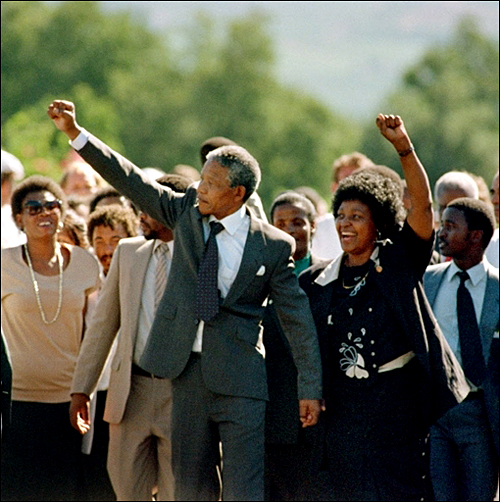
BIO-MANDELA-WINNIE-RELEASEAt some stage the pushing and shoving became dangerous and for a while I thought I was going to be crushed to death. Allan Boesak tried to calm the crowd, but it did not help. Ironically it was the looters that brought relief. At the back some hooligans had looted the liquor store and the police fired their guns. We all stopped pushing and ducked, peering carefully to see what the hell the Police were getting up to.

Two white woman – every hair in place, nails varnished, clearly not the usual struggle suspects – who were standing close to me started praying. “Vandag maak hulle ons nog vrek,” one whispered to the other (“Today they will kill us”) It was not clear whether they were referring to the Police or to members of the crowd. 

When Mandela finally appeared on the balcony a huge roar went up. He delivered the speech, but I can remember very little of what he said. Now we were hugging each other and crying and laughing.

It had suddenly dawned on us while listening to this man: We were going to be free after all. It might take a year or five years, but the end of apartheid was inevitable.

Today twenty years later I still get a chill down my spine when I recall that day. I would not have missed it for the world. Today, again, it feels great to be a South African.

41 Comments

  1. Maggs Naidu says:

    “Today twenty years later I still get a chill down my spine when I recall that day. I would not have missed it for the world. Today, again, it feels great to be a South African.”

    Ditto!

  2. lebogang says:

    zuma had to use madiba memorial release to juxtapose his lackluster speech that was weak in content again …monitoring of ministers will fickle wit the local constituency tney wont do it .for example if min for higher education is not performin(dont even knw what his key performance indicators will be) he will not be recalled as long as sacp/cosatu is still as powerful

  3. sirjay jonson says:

    I was in Canada when Madiba was released and watched it live on the CBC with friends; we were all cheering, drinking champagne and smoking spiffs. It was hosted from SA by Tony Weaver, I believe. Ahh, such dreams, such hopes. It was a day of great expectations and relief for the globe, not just SA .
    And where are we today Prof, if we are being honest. I don’t doubt the horrors of Apartheid, nor wish it had continued, but just perhaps we need to set emotion aside and see reality.

    Personally, my greatest loss in faith was 1) to witness Mbeki’s denial of Aids and Zimbabwe, 2) to personally witness far too much violence, poverty and thuggish government behaviour, and 3) to see Madiba acknowledge JZ when he knew the threat, and thereby put his party ahead of his people.

    Perhaps as the cadres are always saying, “the struggle continues”, only not in the sense they $ee it.

  4. Maybe, if we are lucky, invoking Nelson Mandela will help blind us to the cesspool that is the ANC for another couple of elections. I guess we can only hope…

  5. Andy says:

    Pierre,
    Although Nelson Mandela has been one the greatest living legends alive (and that coming from South Africa), it is also with regret that no worthy leadership “talent” has emerged since the time he left active politics. Well, not that South Africa’s particularly had “political talent” in the past. But the point for me just is: what is a future without Mandela and what does a South Africa look like once Mandela’s died? I think the euphoria and almost mythical presence of Mandela is still keeping South Africa alive in many ways (politically, socially, etc). However, this will soon change in the light of a frail and ailing Mandela. So for me, it is not necessarily about the good heritage which he will be leaving behind. It’s all about what South Africans will do about this heritage in order the shape the South African reality and future, which is of greater importance – this is the sticky point. Rather than reflecting on what was, we ought to reflect on and invest in the future of South Africans with vaguely qualitatively good leadership – something we haven’t had since Mandela’s withdrawal from active politics. I also fondly remember his release; but I fear what is to come, judging by the likes of Zuma & cohorts.

  6. Chris says:

    It is difficult to find someone not regarding Nelson Mandela as a great leader. Not so long ago I listened to an interview with Eugene Terre’Blanche on the radio, and on a question what he thought of Nelson Mandela, his response was, roughly translated: “He was a great Xhosa leader who did his best for this country.”

    I think it is common knowledge that Madiba was not in favour of TM being his successor, and that he was in favour of Ramaphosa being the next president. Sometimes I wonder what would have happened if the ANC had listened to Madiba when he stepped down.

  7. Mikhail Dworkin Fassbinder says:

    My one regret is that Madiba never followed up on his plan to lower the voting age to 14.

    Just think how what a boost this would have been for Malema’s constituency!

  8. Justice says:

    @MDF

    We are already sitting with the situation that no-one in the ANC will reprimand Julius because of the fear that this will result in a loss of votes, and you mourn that this voting block is not bigger? Pandering to intimidation, rule by fear, violence and lack of discipline and education, will result in more intimidation, rule by fear, violence and lack of discipline- but then that is the revolution gospel according to Fanon, isn’t it?

  9. shakira says:

    I wonder where we are going to be in twenty years from now. Are the Malemas and the Mbalulas really the future leaders of this country?

  10. Justice says:

    By the way, to my knowledge, no country in the world has a voting age as low as 14, and some only got to 18 very recently.Clearly most countries think that a person of 14 has not yet developed the maturity and discernment to make wise ballot choices.

    http://www.nationmaster.com/encyclopedia/Voting-age

  11. Mikhail Dworkin Fassbinder says:

    @ Justice

    Justice, do not hold us to the standard of other countries.

    Our young people became politically precocious after being mobilised to struggle for liberation.

    (Cmd Malema began struggling when he turned four.)

  12. Justice says:

    @MDF
    Clearly he made, and admitted to, an error of judgment. See below

    “In 1993, Mandela asked me if I knew of any countries where the minimum voting age was under 18. I did some research and presented him with a rather undistinguished list: Indonesia, Cuba, Nicaragua, North Korea and Iran. He nodded and uttered his highest praise: “Very good, very good.” Two weeks later, Mandela went on South African television and proposed that the voting age be lowered to 14. “He tried to sell us the idea,” recalls Ramaphosa, “but he was the only [supporter]. And he had to face the reality that it would not win the day.”

    Read more: http://www.time.com/time/world/article/0,8599,1821467-3,00.html#ixzz0fLVEt1Lc

  13. Justice says:

    @MDF
    More..

    “Unseen writings of Nelson Mandela which are being sold this week show the anti-apartheid leader at his most candid.

    The former South African president’s archive shows him chiding himself over a “grave error of judgement” when he proposed lowering the voting age to 14.”

  14. Justice says:

    @MDF

    And Julius is still struggling……

  15. sirjay jonson says:

    Ahh youth! Do we remember it? How fanatical we could be at times, how sure we were of what was right and wrong, how distainful we were of our elders. We knew best, right?

    Only now in my elderly years am i seeing the light.

  16. Tony in Virginia says:

    The country remembers Mandela’s first day of freedom.

    While in another part of the country,some little four month old baby, born to a struggle icon and a President of the most important country in Africa, is crawling around with a fraudulent birth certificate.

    How free is a child with a blot (lie) on her birth certificate?

    In township parlance, a fraudulent licence or certificate is referred to as igintsa (is’pikili).

  17. Mikhail Dworkin Fassbinder says:

    Madibe’s instinct, as always, was right first time.

    Indeed, Cuba, Nicaragua, North Korea and Iran had set the voting age youngest.

    Is it a coincidence that these countries are all prime victims of U.S. imperialism?

    Let us hope that our current government continues to do what it can to block the U.S.’s attempts at the U.N. to block North Korea and Iran from developing an independent nuclear deterrent!

  18. Justice says:

    @MDF

    Perhaps Cyrils’ wisdom helped prevent SA from becoming another puppet state of a failed ideology – by 1993, this was clear for all to see.

    What Cuba, North Korea and Iran do have in common is that they are authoritarian dictatorships, where elections are a farce, so what the purpose is of the young voting age, other than increasing voter turnout, remains somewhat mysterious. Fortunately Indonesia and Nicaragua have moved on beyond that political adolescent stage, towards a more mature democratic system.

  19. Mikhail Dworkin Fassbinder says:

    @ Justice

    I cannot say how much it saddens me that you have absorbed the American vision regarding what Bush called the “axis of evil.”

    Cuba, North Korea and Iran have faced the full might of imperialism for decades. Inevtably, harsh measures have been used against U.S. spies. But year after year, the people of these countries, especially Cuba and North Korea, manifest their love by votiing 98.5% in favour of their Great Leaders.

    Cd Mbeki and Cd Pahad shaped our foreign policy in recognition of this reality. One can only hope that our new government will follow a similar course.

  20. Justice says:

    And it saddens me immeasurably that you support the notion that these repressive countries are models to be admired and copied.

    Cuba survived for decades only because of Russia’s support as part of its own “imperialist” agenda. But when Russia could not longer afford to continue to support it (because of the economic failure of the Communist system) Cuba declined into the failed state that it is today,where you cannot even get toilet paper.

    At the end of the Korean War in the 1950s, a cease fire agreement was signed, but the world is still waiting for a peace treaty to be agreed upon and signed between North and South Korea. This will not happen until North Korea modifies its ambitions of ruling a united Korea by taking over South Korea. So who are the “imperialists” here?

    And as for “manifesting their love by voting 98.5% in favour of their great leaders” – are there true democracies in these countries or are they in fact de facto one-party states?; are these “elections” free and fair? (e.g. the election in Iran last year); do the people actually have any choice, or are they driven by intimidation and fear of reprisal should they dare to vote otherwise? Is that what you think constitutes a great role model for us to copy?

    Fortunately we have a great Constitution in SA, with freedom of expression entrenched in it, and you and I are able to have and express totally different points of view without fear of reprisal-until now, at least. This is not possible in Cuba, North Korea or Iran – be honest about that. So let us agree to differ on these matters and simply rejoice in the “freedom” that our constitution provides.

    Thank you

  21. eagleowl says:

    MDF – you can’t be serious! My leg is hurting.

  22. Anonymous says:

    I just want to echo what one listener said on SA FM radio today , that the president missed the opportunity to thank Madiba sincerely when he delivered his speech of the nation address. The listener said the president should have paused and took a minute or so and say something special to Madiba.This special something ,according to the reader , should have come from his heart not from his prepared speech. I agree with this view, after all this was the chief reason why Madiba was there. It was part of the celebration for his release from prison twenty years ago. However , in my view, Madiba was not the centre of attention. I am not saying Zuma should have spent the whole hour singing praises about Madiba , but I am simple saying he was not given sufficient recognition. I may be wrong.
    Before I bow out , does anyone know why Mbeki was not there ? I mean ,the man was conspicous by his absence. All former presidents were there, including the ever – present Dr Kenneth Kaunda !

  23. Justice says:

    @PdV
    “… but I can remember very little of what he said.”

    I can recall that this is when he talked about nationalising the mines and banks. Another big mistake.

    @ eagleowl
    No!!! Really???!! Not (W)MD(F)-

  24. Michael Osborne says:

    @ Justice

    Why such a big mistake to talk about nationalising mines and banks?

    This had been the ANC’s line for decades.

    You would not expect Madiba to emerge from prison and betray the working class within a matter of hours, would you?

  25. Justice says:

    @MO

    Mistake because it resulted in a massive drop on the JSE as investors got very jittery at this thought. If you are of the opinion that the confidence of international investors is immaterial, consider the consequences today, where we have a higher percentage of international investors, through FDI and the profitable carry trade, etc. than in 1991.

    I would have expected him to consider the consequences of his statements, as well as brought himself up to date on the results of nationalisation in other countries that tried it. Political rhetoric is fine for rabble-rousing electioneering- putting this into practise is another matter. If this “has been ANC line for decades”, perhaps its time the ANC reviews these outdated and impractical policy rhetoric-leftovers from a failed ideology.
    Perhaps Madiba should just not have mentioned it at all- that way there would have been no perceived “betrayal”- which came into being anyway when the ANC took the reigns in 1994, and swung to the right economically.

  26. Mikhail Dworkin Fassbinder says:

    What a joy to read Prof Motala’s erudite analysis of the Mpshe/Simelane debates in the Sunday Independent today.

    While not tipping his hand as to where actually he stands on the merits, Professor Motala, does usefully warn that “liberal” jurists and academics should be careful not to come across as “old and ugly” forces.

    (The good professor also indicates that he views calling the President a gangster as not “charming.”)

    Just a pity that Motala sheds no light on the racist conspiracies against Hlophe JP and Motata J. One hopes he will turn to this subject in future contributions.

  27. AliBama says:

    Do you know about: Kwame Nkruma, Julius Nyrere, Martin Luther King,
    Malcolm X…etc. There’s no shortage of charismatic ‘leaders’ –
    including your latest one. At the time I was living in Malawi, and
    remember the comment “now the whole of S.A. is going to be like a Bantustan”.
    The Malawians were/are 30 years more advanced. They knew.
    THere’s a lot to be learned from Zim which is only 15 years more advanced.

  28. Ehud Olmert says:

    • Justice says:
    February 13, 2010 at 9:54 am
    And it saddens me immeasurably that you support the notion that these repressive countries are models to be admired and copied. Cuba survived for decades only because of Russia’s support At the end of the Korean War in the 1950s, a cease fire agreement was signed, but the world is still waiting for a peace treaty to be agreed upon and signed between North and South Korea. This will not happen until North Korea modifies its ambitions of ruling a united Korea by taking over South Korea. So who are the “imperialists” here?And as for “manifesting their love by voting 98.5% in favour of their great leaders” – are there true democracies in these countries or are they in fact de facto one-party states?; are these “elections” free and fair? (e.g. the election in Iran last year); do the people actually have any choice, or are they driven by intimidation and fear of reprisal should they dare to vote otherwise? Is that what you think constitutes a great role model for us to copy?Fortunately we have a great Constitution in SA, with freedom of expression entrenched in it, and you and I are able to have and express totally different points of view without fear of reprisal-until now, at least. This is not possible in Cuba, North Korea or Iran – be honest about that. So let us agree to differ on these matters and simply rejoice in the

    “freedom” that our constitution provides.
    __________________________________________________________________
    Iran, North korea , & Cuban history is as I am sure very Familiar to Dworkin,?

    “I cannot say how much it saddens me that you have absorbed the American vision regarding what Bush called the “axis of evil.”Cuba, North Korea and Iran have faced the full might of imperialism for decades. Inevtably, harsh measures have been used against U.S. spies. But year after year, the people of these countries, especially Cuba and North Korea, manifest their love by votiing 98.5% in favour of their Great Leaders”
    ________________________________________________________
    These countries all have by characterization constitutions which profess A FEW ideals:
    Iran if you know their history- advances the cultural, social, political, and economic institutions of Iranian society based on Islamic principles and norms, which represent an honest aspiration of the Islamic Ummah. This objective was exemplified by the nature of the great Islamic Revolution of Iran, after experiencing the anti-despotic and anti-colonialist movements centred on the oil industry. The constitution is based on the following: belief, the creation of a favourable environment for the growth of moral virtues based on faith and piety and the struggle against all forms of vice and corruption; raising the level of public awareness in all areas, through the proper use of the press, mass media, and other means; free education and physical training for everyone at all levels, and the facilitation and expansion of higher education; strengthening the spirit of inquiry, investigation, and innovation in all areas of science, technology, and culture, as well as Islamic studies, by establishing research centres and encouraging researchers; the complete elimination of imperialism and the prevention of foreign influence, the elimination of all forms of despotism and autocracy and all attempts to monopolize power; Iran’s leaders has authoritarianism down to a discipline. Before elections they project a democratic face to the world. But times when citizenry get out of hand they use overwhelming force to nip them in the bud (shoot to kill). Sound familiar?
    North Korean Constitution:
    In September 2009, North Korea revised its constitution removing all references to communism and enshrining Kim Jong-il as Supreme Leader. The term ‘communism’ was replaced with Songun respect for human rights for the first time. The constitution establishes North Korea’s official name and its status as a socialist state. The country follows the Chinese model of the people’s democratic dictatorship. It guarantees civil and political rights, such as freedom of expression, the right to elect officials, the right to a fair trial, and freedom of religion. It asserts the right of every citizen to work, education, opinions, food, and health care. Ring a bell?
    Cuban Preamble:
    We declare our will that the law of laws of the Republic be guided by the vision of José Martí; The fundamental law of our republic to be the tribute of Cubans to the full dignity of man; adopted by means of our free vote in a referendum, that all the regimes based on the exploitation of man by man cause the humiliation of the exploited and the degradation of the human nature of the exploiters; that only under socialism and communism, when man has been freed from all forms of exploitation – slavery, servitude and capitalism – can full dignity of the human being be attained. Vaguely familiar> Corresponding to the above and a host of double standards, The USA, still wants to sign an agreement to sell nuclear fuel to India for its reactors, although India has not signed the Nuclear Non-Proliferation Treaty (NPT). How threatening is this to Pakistan? The Uk is currently under inquiry into the Iraq war, Israel has as many as 400 nuclear weapons since the late 60s, & now has a fully functional arsenal pointing at its neighbors including Iran. Not to mention the chemical warfare they engaged against the Palestinians in 2008/9.
    _____________________________________________________________
    SA similarly has a constitution whether flexible, inflexible supreme , superimposed or indigenous the point To the President & all his Men & “Women”, get on with the Fucking JOb!

  29. Gwebecimele says:

    http://www.timeslive.co.za/news/article306915.ece

    There must be a school of corruption somewhere. All these cases are similar and Vavi right we need to start auditing peoples lives.

  30. Maggs Naidu says:

    It seems that someone is listening.

    “THE National Treasury has launched an investigation into ­corruption in the Limpopo provincial government’s tender and ­procurement processes.”

    http://www.citypress.co.za/Content/Politics/News/2259/4e3003b80fa845f893ed41f14bd53a97/14-02-2010-02-00/Pravin_guns_for_fat-cat_cadres

    and

    “SUSPENDED chief director of roads management in the North West department of public works, roads and transport Eddie Thebe is expected to answer to 10 charges of gross misconduct during a disciplinary hearing in Mafikeng today”

    http://www.sowetan.co.za/News/Article.aspx?id=1113991

  31. Gwebecimele says:

    @ Maggs

    Where is this corruption busting animal we have been talking about?
    I know the individuals (CFO + HOD suspended) in NW case and they have been in govt for the last 14 yrs lets look in their past as well.

  32. Maggs Naidu says:

    Gwebecimele says:
    February 15, 2010 at 11:34 am

    “Where is this corruption busting animal we have been talking about?”

    It’s lurking in the corridors of power looking for “the weakest link”!

    :)

  33. Mikhail Dworkin Fassbinder says:

    Maggs, you are a ray of light. When all is bleak, we count on you to find and share with us the “good news.” Something IS being done!

    And the future looks even better, what with all the accountability mechanism JZ announced last week!

  34. Maggs Naidu says:

    Mikhail Dworkin Fassbinder says:
    February 15, 2010 at 11:45 am

    “And the future looks even better, what with all the accountability mechanism JZ announced last week!”

    Face reality Dworky.

    It’s really, really bad out there – driving in the busy streets of Joburg, in shopping malls, in the workplaces, anywhere where people gather there’s signs of utter dismay, doom and gloom.

    Joy and happiness has disappeared from families. Students in schools and universities have stopped studying. Even children have stop playing and laughing.

    Hospitals have stopped treating patients. Businesses have all but stopped operating. Forget luxuries, there’s not even a loaf of bread to be found these days. Banks are closed (well not really closed they’re open but they have no money so all the banks vaults are used for the homeless). There’s no fuel. Electricity is about to be cut. We have had the last of potable water. There’s no planes coming in or going out of ORT. Harbours are shut.

    Forget the hope for the future – it’s all doom and gloom out there.

    All that because our President had a child out of wedlock!

    There’s just no peace and friendship.

    Dear, oh dear, oh dear! what are we to do????”?

    p.s. It’s so bad that Malema has become a carpenter.

    It’s so bad that taxi drivers are following the rules of the road.

    It’s so bad that Zuma wants to be adopted by Madonna.

  35. Friend says:

    I saw the history channel story of Madiba and it was really sad to realize just how bad the people were treated during that time, I cannot sit and listen to the rantings of racists in this lifetime from people who doesn’t at have any remorse or at least that bit of insight. After the release the documentary states that he met with the most important and richest people of our planet, amongs others Mr. Oppenheimer at his Santon farm and all I’m thinking now is how I would be able to spread this story, without mentioning the state of our nation as we discuss it on this blog, if you know what I mean? To kind of not let the receiver of that message in on any friendships between politicians and businessmen so that no one will make any assosiations whatsoever with whatever it is that is not being said here.

  36. Justice says:

    @Ehud Olmert

    There is a large, black chasm between the window-dressing of what is written on a piece of paper, and what constitutes reality. These countrys’ Constitutions are the products of spin doctors’ dreams-and serve the purpose of political tourist sightseeing.
    We all know what happened pre-, during and after the elections in Iran last year; we all know the abysmal human rights records, including lack of freedom of thought and speech, freedom of the press, freedom of movement and communication of these countries; we all know the draconian punishment and other consequenes of opposing the system. Thank goodness we are not like them.

  37. Mikhail Dworkin Fassbinder says:

    @ Maggs

    Maggs, I am afraid you are, as we say, “over-egging the pudding.”

    Just this morning, I saw a child laughing in delight.

  38. Maggs Naidu says:

    Mikhail Dworkin Fassbinder says:
    February 15, 2010 at 15:54 pm

    “Just this morning, I saw a child laughing in delight.”

    Was it Juju?

  39. AliBama says:

    The apparent 14 yo. voter who was praising the: *PRESENT* ‘Joy and happiness’ in shopping-malls,
    schools and universities, might note that the NOW-orgasm may have consequences when you’re 50%
    older. Are there any readers who can look beyond the here-and-now to confirm the similar
    euphoria during the Zim one-decade of freedom stage?

  40. Gwebecimele says:

    http://www.sowetan.co.za/News/Article.aspx?id=1114614

    Where is Kortbroek? De Klerk is a retired member of the ANC/NP.

    Perhaps just like PW Botha and others we will say nice things about him at his funeral.

  41. Gwebecimele says:

    http://www.timeslive.co.za/local/article314453.ece

    Put aside the burning of libraries and other lawlessness activities, the communities are reviewing performance of municipal officials. Can’t wait for local govt elections. Put a drunkard or lazy official the voters will respond.

Discussion Area - Leave a Comment